May 2, 2026
7 Early Churn Signals Every D2C Founder Must Track
tanishka-ratn
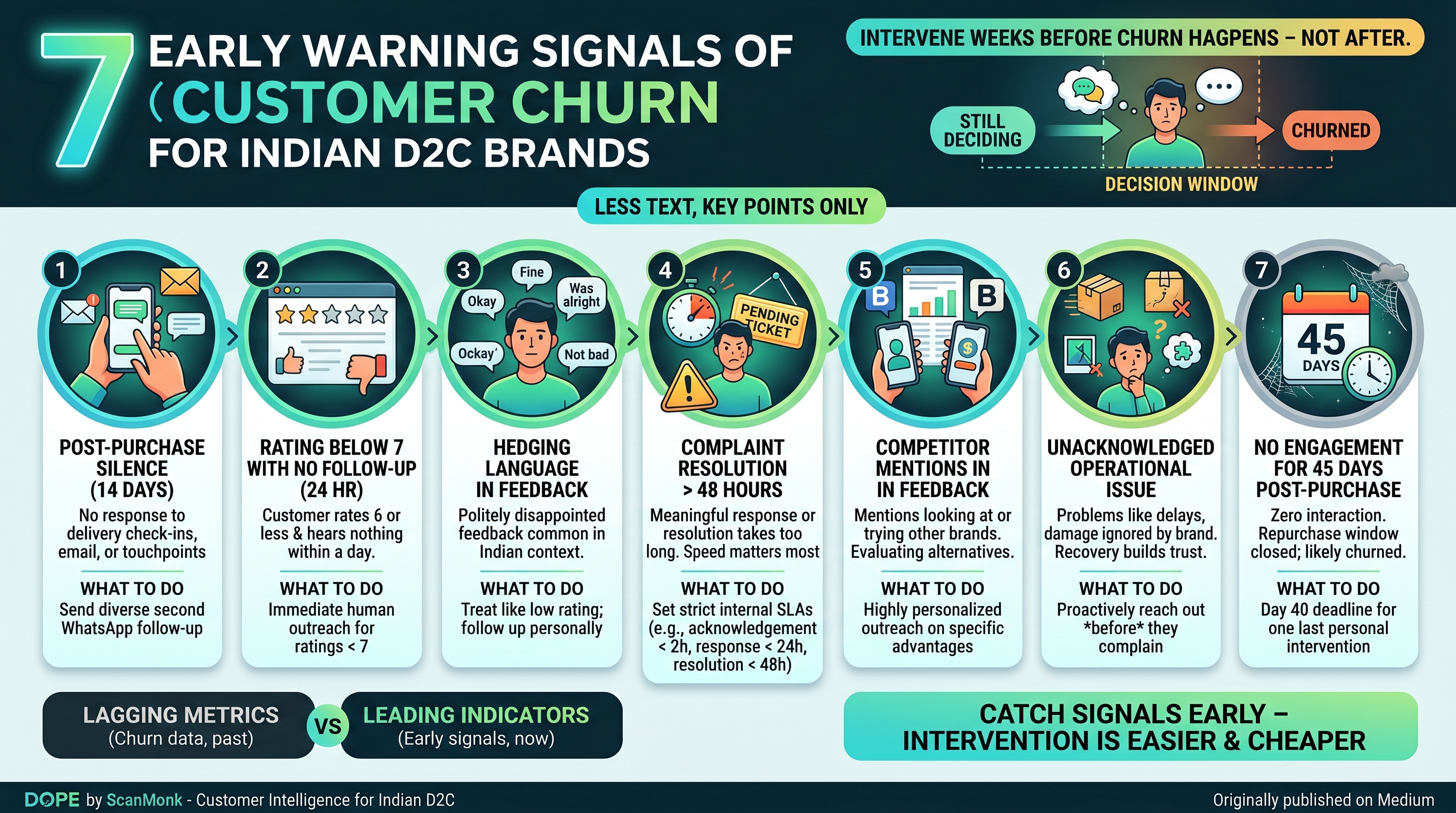
Most D2C brands find out a customer has churned only after it is too late. These 7 signals appear weeks before a customer stops buying - and every founder can start tracking them today.
Customer churn in Indian D2C does not happen suddenly.
It builds slowly - one small frustration at a time, one unanswered message at a time, one unresolved issue at a time. By the time your analytics show a drop in repeat purchase rate, the customers behind that number have already made their decision weeks ago.
The brands that consistently achieve 35-45% repeat purchase rates in India share one characteristic - they have learned to read the signals that appear before churn happens, not after.
This piece covers the 7 most reliable early warning signals - what they look like, why they matter, and what to do when you spot them.
Why Early Signals Matter More Than Churn Data
Most brands track churn as a lagging metric. They look at repeat purchase rate at the end of the month, see it has dropped, and try to reverse engineer what went wrong.
This is useful for understanding the past. It is useless for saving the customers who are about to leave right now.
Early churn signals are leading indicators - they appear while there is still time to intervene. A customer showing three of these signals has not churned yet. They are deciding whether to. That decision window is where retention happens.
The earlier you catch the signal, the easier and cheaper the intervention. A well-timed WhatsApp message costs nothing. A win-back campaign for a customer who left three months ago costs significantly more and converts at a fraction of the rate.
Signal 1 - Post-Purchase Silence
A customer who does not respond to any post-purchase communication within 14 days of delivery is showing the strongest single predictor of churn.
This includes - not opening the delivery confirmation email, not responding to a WhatsApp check-in, not engaging with any post-purchase touchpoint from the brand.
Why this matters - the purchase experience is freshest in the first two weeks. A customer who felt genuinely good about their order will typically respond positively to a check-in during this window. Silence means one of two things - the experience was neutral enough that no engagement feels necessary, or the experience was negative enough that the customer does not want to engage.
Either way, silence at this stage is a warning sign.
What to do - send a second WhatsApp message with a different angle. Not "how was your experience" again - try "is there anything we can help you with regarding your recent order?" This softer approach surfaces issues that a direct feedback request might not.
Signal 2 - A Rating Below 7 With No Follow-Up
If a customer rates their experience 6 or below and receives no follow-up from the brand within 24 hours, their churn probability increases significantly.
The rating itself is not the problem. A 5 out of 10 rating is salvageable - brands recover dissatisfied customers all the time. The problem is the silence that follows.
When a customer tells you something was wrong and hears nothing back, two things happen simultaneously - they conclude that the brand does not care, and they begin actively looking for alternatives.
What to do - build a trigger into your feedback system that flags any rating below 7 for immediate human follow-up. Not an automated response. A personal message acknowledging what they said and asking what can be made right. This single intervention recovers a significant percentage of at-risk customers.
Signal 3 - Hedging Language in Feedback
This signal requires reading feedback responses carefully - and most brands miss it entirely.
Hedging language is feedback that sounds neutral but signals dissatisfaction. Words and phrases like "okay," "fine," "was alright," "expected a bit more," "not bad," "decent enough," and "could be better" are not neutral responses. They are politely disappointed customers who did not want to say something harsh.
In the Indian cultural context, direct negative feedback is relatively uncommon. Indian consumers are more likely to express dissatisfaction through soft hedging than through a strongly worded complaint. This makes hedging language an especially important signal for Indian D2C brands specifically.
NLP sentiment analysis catches this automatically - categorizing hedging language as negative sentiment rather than neutral. For brands analyzing feedback manually, reading for hedging language requires specific attention.
What to do - treat any response containing hedging language the same way you would treat a low rating. Follow up personally, ask what could have been better, and create an opportunity for the customer to share the real concern.
Signal 4 - A Complaint That Took More Than 48 Hours to Resolve
Speed of resolution matters more than the resolution itself for customer retention.
A customer who raised a complaint - about a damaged product, a delivery issue, a wrong item, anything - and waited more than 48 hours for a meaningful response has experienced something that is very difficult to recover from. The frustration of waiting compounds on top of the original issue.
Research consistently shows that complaint resolution speed is one of the strongest predictors of whether a dissatisfied customer returns. Fast resolution - even when the outcome is imperfect - retains customers at a significantly higher rate than slow resolution.
What to do - set a strict internal SLA for complaint response: first acknowledgment within 2 hours, meaningful response within 24 hours, resolution within 48 hours. Track this metric weekly. When you miss it, note which customers were affected - these are your highest churn risk accounts right now.
Signal 5 - Competitor Mentions in Feedback
When a customer mentions a competitor in their feedback - even in a seemingly neutral context - it is a clear signal that they are actively evaluating alternatives.
Examples of what this looks like in practice - "I have been trying [Competitor Brand] as well," "a friend recommended [Competitor] to me," "I saw [Competitor] has something similar," or "compared to [Competitor], your packaging is better but delivery is slower."
The competitive mention tells you two things. The customer is not exclusively loyal to your brand. They are in a consideration phase - which means they have not made a final decision yet.
What to do - flag every feedback response that contains a competitor name for immediate review. These customers need proactive outreach that reinforces your brand's specific advantages - not a generic retention campaign, but a personalized message that addresses the specific comparison they made.
Signal 6 - An Operational Issue That Was Not Acknowledged
Operational failures - damaged packaging, delayed delivery, wrong product, missing item - are highly forgivable when acknowledged fast. They become permanent retention damage when ignored.
The customer's experience of an operational failure has two chapters. Chapter one is the failure itself. Chapter two is how the brand responded. Brands that handle chapter two well - fast acknowledgment, genuine apology, clear resolution - actually build stronger customer relationships through failures than through smooth experiences. The recovery creates trust.
Brands that never acknowledge the failure leave the customer with only chapter one. That chapter becomes the entire story of their experience with the brand.
What to do - build a system to identify customers who experienced an operational issue based on logistics data, delivery partner feedback, or customer service contacts - and proactively reach out before they have to complain. "We noticed your delivery was delayed and wanted to personally apologize" is significantly more powerful than responding to a complaint.
Signal 7 - No Engagement for 45 Days Post Purchase
A customer who has had zero interaction with your brand across any channel in the 45 days following their first purchase is almost certainly churned.
This is the final signal - the one that confirms what earlier signals were warning about. At 45 days, the repurchase window for most Indian D2C categories has closed. The customer has moved on.
At this point, recovery requires a different approach - win-back campaigns, special offers, re-engagement sequences. All of these are more expensive and lower-converting than earlier interventions would have been.
This signal is most valuable as a trigger for escalated action - not as the first time you notice a customer is at risk, but as the deadline for one final intervention attempt before marking the customer as churned.
What to do - at day 40, before the 45-day window closes, send a personal outreach that is genuinely different from anything you have sent before. Not a discount code email - a personal message from the founder or a senior team member. "We noticed we have not heard from you in a while and wanted to personally check in." The personalization of this outreach is what gives it a chance of working.
How to Track These Signals Without a Data Team
The challenge for most Indian D2C brands is not understanding these signals - it is having the system to catch them consistently across hundreds or thousands of customers simultaneously.
Manual tracking works at low order volumes. For every 50 orders per month, a weekly review of the following is manageable with one person spending 2 hours:
Go through all post-purchase feedback received that week. Flag any rating below 7. Read all responses for hedging language. Check response times on any complaints received. Note any customers who have passed the 14-day silence mark. Identify customers approaching the 45-day mark with no second order.
At higher volumes - 200 orders per month and above - this becomes a full-time job. This is the point where automated feedback collection, NLP sentiment analysis, and structured churn risk scoring become necessary rather than optional.
Putting It Together - The Weekly Churn Signal Review
Building a simple weekly habit around these signals is more valuable than any analytics tool.
Every Monday, spend 30 minutes on this review:
Which customers from last week showed post-purchase silence at day 14? Which feedback responses from last week contained ratings below 7 or hedging language? Which complaints from last week took more than 48 hours to resolve? Which customers mentioned competitors in their feedback? Which customers are approaching day 45 with no second order?
The answers to these five questions give you your churn risk list for the week. The customers on that list need proactive outreach before the week is out.
This is customer intelligence in its simplest form - not complex analytics, not machine learning, not expensive software. Just consistent attention to the signals your customers are already sending.
Frequently Asked Questions
How many of these signals does a customer need to show before they are considered high churn risk? Any single signal warrants attention. Two or more signals appearing together for the same customer indicates high churn risk and should trigger immediate personal outreach.
Can these signals be tracked automatically? Yes - NLP-based feedback analysis can automatically detect sentiment, hedging language, and competitor mentions. Behavioral signals like post-purchase silence and 45-day inactivity can be tracked automatically through order management system data combined with feedback engagement data.
What is the most important signal to track first if you can only track one? Post-purchase silence at day 14. It is the earliest, most reliable, and most actionable signal available - and it requires nothing more than checking which customers have not responded to any post-purchase outreach within two weeks of delivery.
How do these signals vary across D2C categories? The signals are consistent across categories, but the thresholds vary. For high-frequency categories like food and personal care, the 45-day window shortens significantly - inactivity at 21-30 days is already a churn signal. For lower-frequency categories like home or fashion, the window extends.
Is it possible to have too many false positives - customers flagged as churn risk who were actually going to return anyway? Yes - and that is fine. The cost of proactively reaching out to a customer who was going to return anyway is minimal. The cost of missing a customer who was about to churn is losing them permanently. Err on the side of more outreach, not less.
DOPE by ScanMonk is India's fully outsourced customer intelligence platform for D2C brands - collecting feedback via calls, WhatsApp, and email, then delivering NLP-analyzed churn predictions and actionable insights. Learn more at dope.scanmonk.com
Originally published on Medium. Follow DOPE by ScanMonk for weekly D2C intelligence insights.