November 27, 2025
Fake Customer Care Number Scam: How Fraudsters Hijack Your Search Results
tanishka-ratn
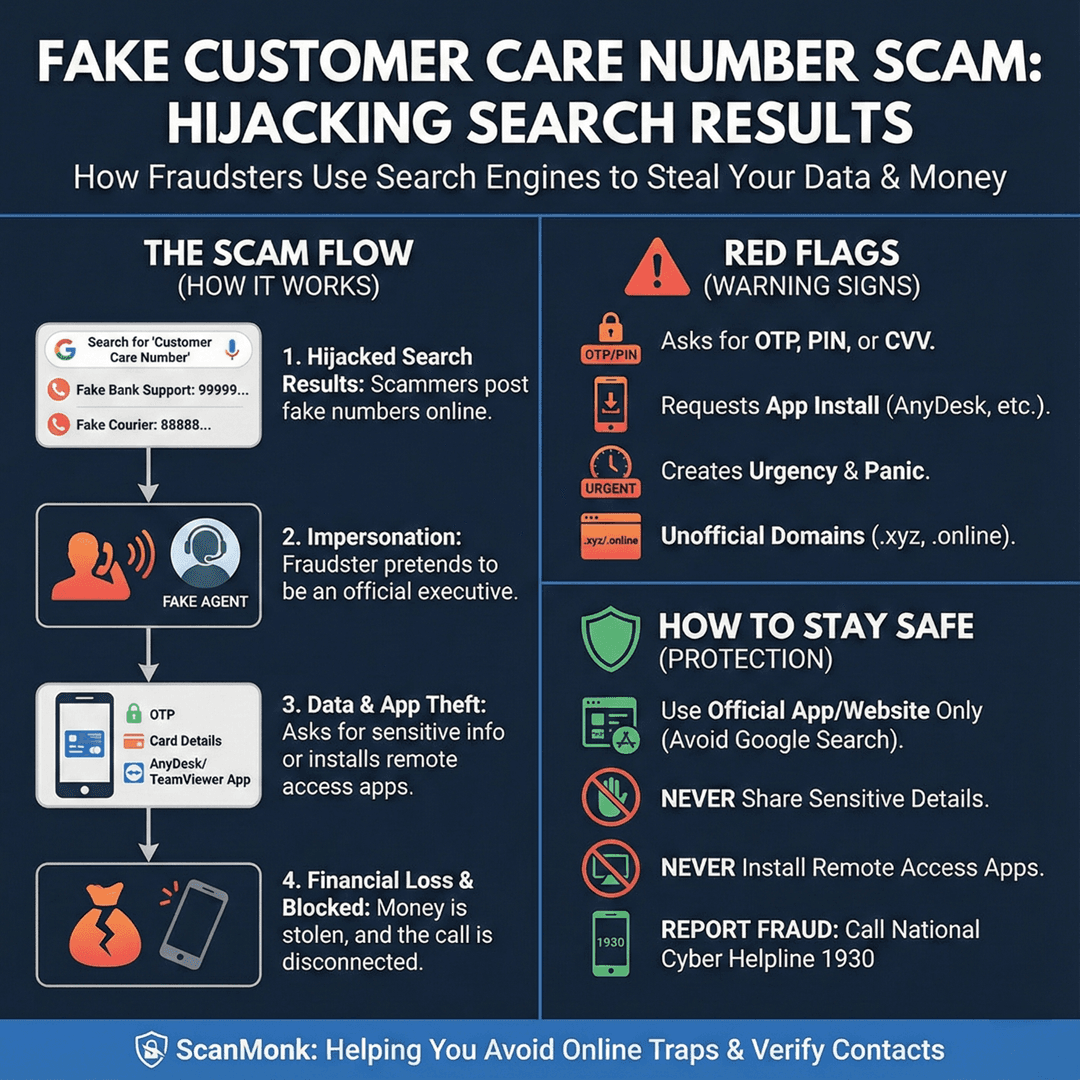
In India, one of the fastest-rising online frauds is the Fake Customer Care Number Scam.
This scam targets people who urgently search for customer care numbers of banks, courier companies, airlines, e-commerce platforms, payment apps, and service providers.
Because scammers manipulate search engines, ads, and social media listings, victims often end up calling a fake support number instead of the real one.
Once connected, the fraudster pretends to be an official support agent and tricks users into sharing personal details, installing remote access apps, or making harmful payments.
This blog explains how the scam works, why people fall for it, and how to protect yourself with safe online practices.
How the Fake Customer Care Number Scam Works
1. Fake Numbers Appear on Google and Social Media
Scammers create websites, Google Business listings, and ads with fake customer care numbers for:
- Banks
- Airlines
- Courier companies
- Food delivery apps
- E-commerce brands
- Payment apps
- Smartphone brands
- Internet service providers
These numbers appear high in search results, making them look legitimate.
2. Scam Websites and Fake Reviews
Fraudsters design websites that look identical to official sites.
They add:
- Fake logos
- Realistic interface
- High-volume fake reviews
- Clickable call buttons
Victims trust the design and call immediately.
3. Impersonating Customer Support Representatives
Once a victim calls, the scammer confidently introduces themselves as:
- “Bank Support Executive”
- “UPI Helpdesk”
- “Courier Verification Team”
- “E-commerce Support”
- “RBI Complaint Cell”
They speak in a professional tone and use scripted responses.
4. Asking for Personal and Financial Details
The fraudster asks the caller to provide:
- Full name
- Phone number
- Aadhaar number
- Card number
- OTP
- Account details
The excuse is always verification, refund processing, or KYC updating.
5. Installing Screen-Sharing Apps
Many scammers tell victims to install remote access apps like:
- AnyDesk
- TeamViewer
- QuickSupport
They claim it is needed to “check your issue”.
Once installed, the scammer can see everything on the user’s screen, including UPI apps and banking details.
6. Fake Refund or Chargeback Procedure
Fraudsters trick users into entering a UPI PIN under the pretext of:
- Fixing a transaction
- Issuing a refund
- Reversing a failed payment
This results in instant money loss.
7. Call Disconnected After Money Transfer
Once the money is transferred, the scammer immediately disconnects the call, blocks the victim, and deletes the fake number.
Why This Scam is So Effective
1. Urgency and Panic
People usually search for customer care numbers when:
- A payment has failed
- A product has not arrived
- A courier is missing
- A refund is stuck
- A card has been charged
This urgency makes them vulnerable.
2. Fake Websites Look Authentic
Fraudsters use official logos and brand colors, making it difficult for a regular user to distinguish between real and fake pages.
3. Easy Search Manipulation
Scammers use SEO tricks and promoted listings to appear at the top of search results.
4. Trust in Google Results
Most users assume the first number shown on Google is always official.
Red Flags to Identify a Fake Customer Care Number
- Website is not from the official domain
- The number appears on random blogs or forums
- Poor grammar or spelling errors on the site
- Scammer asks for OTP or UPI PIN
- Request to install screen-sharing apps
- Caller speaks too fast, pushing urgency
- Payment is requested for “verification fees”
- The site has multiple phone numbers
- WhatsApp-only support number
If any of these signs appear, you are dealing with a fraudulent number.
How to Stay Safe from Customer Care Scams
1. Never Search for Customer Care Numbers on Google
Always use official sources:
- App’s built-in help section
- Official website
- Verified social media profiles
- Product packaging
- Official emails or invoices
2. Do Not Share Sensitive Details
No legitimate support team will ever ask for:
- OTP
- PIN
- CVV
- Aadhaar details
- Full card number
3. Never Install Screen-Sharing Apps
Banks and e-commerce platforms do not use remote access tools.
4. Avoid Calling Numbers Found on Social Media
Scam pages often post fake numbers under comments.
5. Cross-Check the Domain Name
Official Indian customer care sites end with:
- .com
- .in
- .gov.in
- .co.in
Not random domains like:
- .xyz
- .online
- .shop
6. Report Fake Numbers Immediately
If you spot a fake listing, report it on:
- Google Maps
- Social media
- Cyber helpline 1930
How ScanMonk Helps Users Avoid Such Scams
ScanMonk regularly alerts users about:
- Fake customer support numbers
- Phishing websites
- Duplicate e-commerce sites
- Fake apps
- Fraudulent payment links
By promoting scam awareness and providing verification tools, ScanMonk helps users confidently navigate online platforms and avoid dangerous traps.
Conclusion
The Fake Customer Care Number Scam is one of the most dangerous online frauds in India because it exploits urgency and trust.
Fraudsters manipulate search results to make users call fake support numbers, then steal personal information, install remote access apps, and trick victims into making payments.
The safest approach is to always rely on official sources, avoid searching helpline numbers on Google, and never share confidential details.
If you face such incidents, immediately report them to the National Cyber Crime Helpline at 1930.