November 27, 2025
SIR Form Voter ID Verification Scam: The New OTP Fraud Targeting Citizens Across India
tanishka-ratn
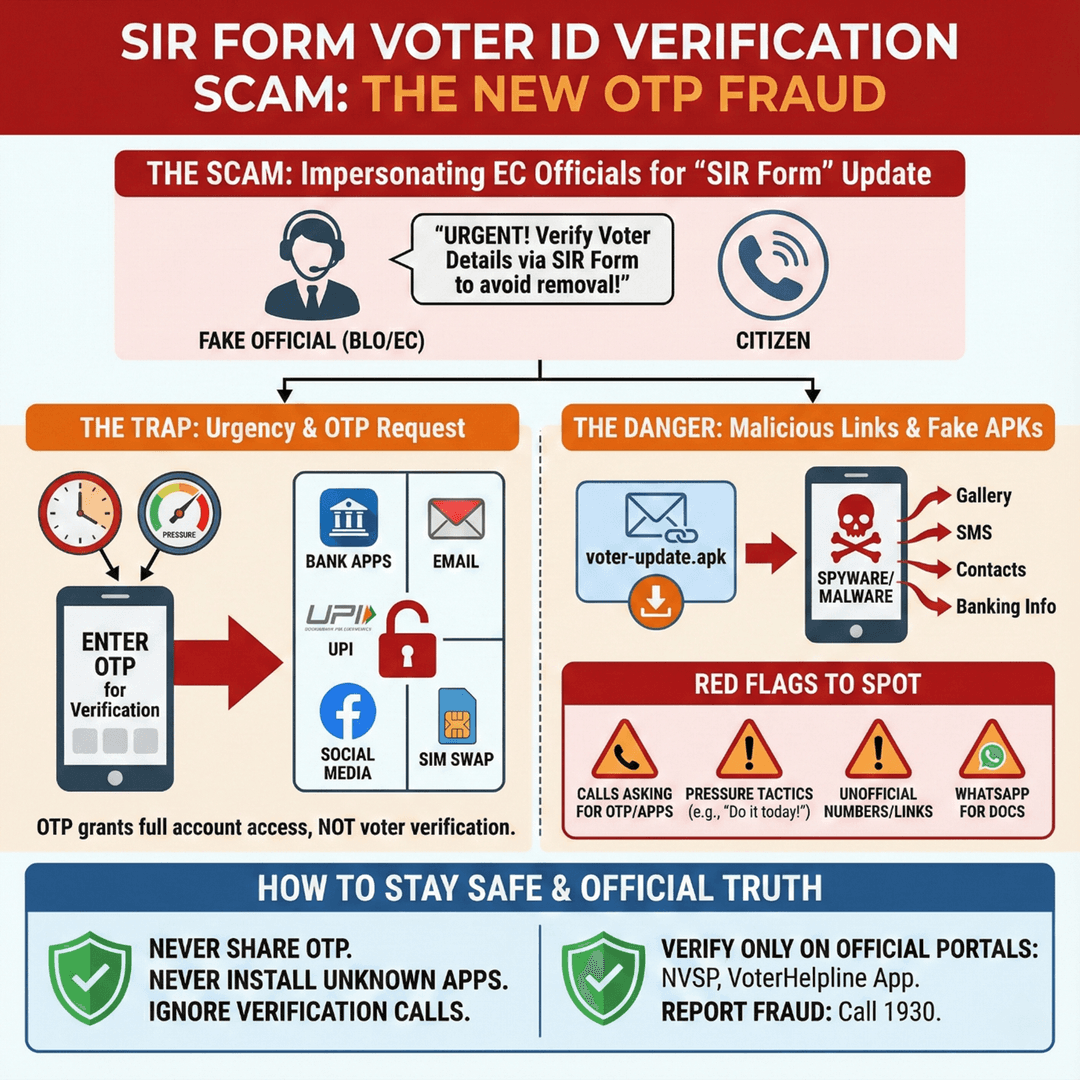
A new type of digital fraud has been reported across India where scammers impersonate officials from the Election Commission and ask citizens to share a One-Time Password (OTP) under the pretext of completing or verifying their voter details.
This scam is popularly called the SIR Form Voter ID Verification Scam.
While the message looks official and the caller speaks confidently, the entire process is a trap designed to steal personal information, access digital accounts, and commit financial fraud. This blog explains how the scam works, why it is dangerous, and what users must do to stay safe.
What Is the SIR Form Scam?
1) In this scam, fraudsters contact people through:
- Phone calls
- WhatsApp messages
- SMS
- Fake verification links
They claim that a person's Voter ID details need to be updated or verified through a process known as the SIR Form.
2) The scammers then ask victims to share:
- An OTP received on their phone
- Personal identity details
- Documents
- or to download a suspicious app
All of this is presented as an urgent requirement for voter verification.
However, the Election Commission has clearly stated that no such SIR verification requires OTP sharing or phone-based authentication.
How the Scam Actually Works
1. The Scam Starts With a Verification Call
The scammer introduces themselves as:
- BLO (Booth Level Officer)
- Election Commission official
- Voter Enrollment Agent
- Government verification executive
They claim that your voter details are incomplete or pending.
2. Creating Urgency and Pressure
The caller uses fear tactics such as:
- Your name may be removed from the voter list
- Your voter ID is not valid
- Your details must be updated today
- Your polling booth has changed
- Your name needs Aadhaar linkage
This creates panic and forces the victim to cooperate.
3. OTP Is Requested in the Name of Verification
The scammer says:
- “A message has been sent to your phone”
- “Share the OTP to verify your identity”
But this OTP is not for voter verification.
It is for:
- Logging into your email
- Resetting your UPI accounts
- Accessing your social media
- Getting into your bank apps
- Authorizing SIM swap requests
Once the OTP is shared, the scammer gains direct access.
4. Fake APKs or Links Are Sent
Some scammers send:
- A link
- A downloadable APK file
- A website claiming to be voter update portal
These contain spyware or remote access malware.
Installing these apps gives scammers:
- Access to gallery
- SMS
- Contacts
- Banking apps
- Device information
This enables high-risk financial fraud.
5. Identity Theft Begins
Once personal details are collected, scammers can:
- Clone your identity
- Take loans in your name
- Create new accounts
- Commit cybercrime using your credentials
The victim is usually unaware until significant damage has occurred.
Why the SIR Form Scam is Dangerous
1. It Targets Every Citizen
Voter verification is a nationwide process, making this scam easy to execute at scale.
2. It Appears Extremely Official
The terminology sounds government-like and familiar.
3. OTP Sharing Leads to Full Account Takeover
A single OTP can compromise:
- Google account
- Bank accounts
- UPI apps
- Digital wallets
4. Fake Apps Steal Complete Phone Data
Malicious APKs grant full device-level access.
5. Scammers Gain Your Personal Identity Documents
These can be misused for fraudulent loans and transactions.
Red Flags to Identify a Fake Voter Verification Call
- Caller asks for OTP
- The caller uses urgency or pressure
- The number is not an official government helpline
- The message contains suspicious links
- The caller asks to download an app
- Incorrect or mispronounced details about your voter information
- Caller refuses to provide official email or employee ID
- WhatsApp messages sent instead of official communication
If any one of these signs appears, the communication is fraudulent.
What the Election Commission Has Officially Clarified
The Election Commission does not:
- Call citizens for voter verification
- Ask for OTP
- Ask for Aadhaar linkage through phone
- Ask to install any app for verification
- Collect personal documents through WhatsApp
- Send links for voter authentication
All genuine voter-related services are available only on:
- NVSP official portal
- VoterHelpline app
- State CEO websites
- Official Election Commission channels
Anything outside these sources is unsafe.
How to Stay Safe from the SIR Form Scam
1. Never Share OTP With Anyone
No government authority will ever ask for OTP.
2. Never Install Unknown APK Files
These files are the biggest source of malware.
3. Do Not Click Unknown Links
Always verify URLs before opening them.
4. Verify Information Directly on Official Websites
Use only official portals for voter services.
5. Ignore Verification Calls
Government departments do not verify by phone.
6. Educate Family Members
Elderly people are most vulnerable.
7. Report Fraud Immediately
If you suspect a scam, call the Cyber Crime Helpline: 1930
or file a complaint on the National Cybercrime Portal.
How ScanMonk Helps Citizens Stay Safe
ScanMonk is committed to protecting Indian users from online frauds through:
- Scam alerts
- Fake website identification
- E-commerce safety education
- Awareness content
- Real-time fraudulent pattern detection
As India’s E-Commerce Trust Layer, ScanMonk helps users verify links, understand risk signals, and identify digital threats before they cause harm.
Conclusion
The SIR Form Voter ID Verification Scam is dangerous because it uses the trust of a national institution to trick citizens into sharing OTPs and personal data.
Understanding how the scam works and learning to identify red flags is the most effective way to stay protected.
Users must avoid sharing confidential information, rely only on official platforms, and immediately report suspicious activity.
The more people become aware, the harder it becomes for scammers to exploit innocent citizens.