May 2, 2026
The Complete Guide to WhatsApp Customer Feedback Collection for Indian D2C Brands
tanishka-ratn
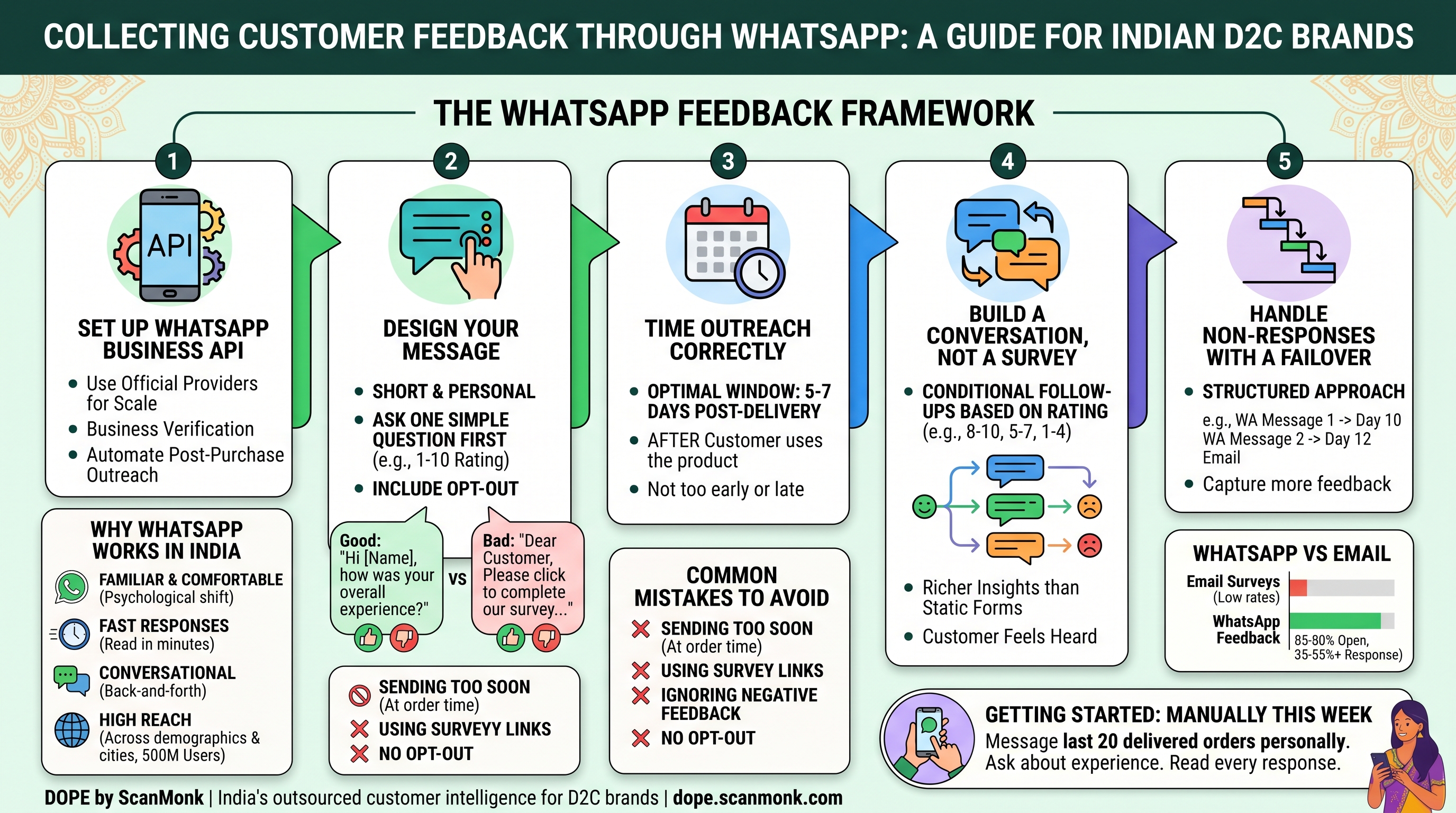
WhatsApp is where 500 million Indians spend their time. Yet most D2C brands are still sending feedback requests via email and wondering why nobody responds. This guide covers everything you need to know about collecting customer feedback through WhatsApp - practically, effectively, and at scale.
If you run a D2C brand in India, you already know that getting customers to respond to anything is hard.
Email open rates hover around 15-20% for post-purchase communication. Survey completion rates sit at 3-8%. You send feedback requests to 1000 customers and hear back from maybe 50. Those 50 are usually your most loyal customers or your most frustrated ones - rarely the silent majority in the middle.
Meanwhile, your customers are on WhatsApp. Every single day. Multiple times a day.
WhatsApp has 500 million active users in India. Messages are opened at a rate of 85-90%. Responses come within minutes, not days. It is where Indians communicate with family, friends, and increasingly - with brands they trust.
The gap between where brands are sending feedback requests and where customers actually are is costing Indian D2C brands enormous amounts of customer intelligence every month.
This guide covers how to close that gap - completely and practically.
Why WhatsApp Works for Customer Feedback in India
Before getting into the how, it is worth understanding why WhatsApp specifically is so powerful for feedback collection in the Indian context.
Familiarity and comfort
For most Indian consumers, WhatsApp is the primary communication channel - more comfortable than email, more personal than a website form. When a brand reaches out via WhatsApp, it feels like a conversation rather than a survey. That psychological shift changes how customers respond - more openly, more honestly, and more often.
Response speed
WhatsApp messages get seen fast. The average WhatsApp message in India is read within 3-5 minutes of receipt. Email may sit unread for days - or never get opened at all. For time-sensitive post-purchase feedback, this speed matters enormously.
Conversational format
WhatsApp naturally supports back-and-forth conversation. A customer who replies to a feedback message can be asked a follow-up question immediately - turning a single data point into a rich conversation. This is impossible with traditional survey tools.
Reach across demographics
Unlike email, which skews toward urban, educated, English-comfortable consumers, WhatsApp penetration in India cuts across demographics - tier 1 and tier 2 cities, multiple languages, age groups from 18 to 60. Your feedback data becomes genuinely representative of your customer base.
The WhatsApp Feedback Framework - Step by Step
Step 1 - Set up WhatsApp Business API
For systematic feedback collection at scale, you need WhatsApp Business API - not just the regular WhatsApp Business app.
The regular WhatsApp Business app works for manually sending messages to individual customers. For automated post-purchase outreach triggered by order events, you need the API.
To get access:
Apply through an official WhatsApp Business Solution Provider - companies like Interakt, Wati, or AiSensy in India offer this. The process involves business verification and takes 3-7 days.
Get your message templates approved. WhatsApp requires pre-approved templates for outbound messages. Templates need to be conversational, clearly identify your brand, and include an opt-out option.
Connect the API to your order management system so feedback triggers go out automatically based on delivery confirmation.
Step 2 - Design your feedback message
The message design is where most brands make mistakes. WhatsApp feedback messages that work well share three characteristics - they are short, they are personal, and they ask one clear question first.
A message that works:
"Hi [Name], this is [Brand]. Your order of [Product] was delivered recently - hope you love it. Quick question - how was your overall experience with us? Reply with a number from 1-10. 😊
Reply STOP anytime to opt out."
A message that does not work:
"Dear Valued Customer, We hope this message finds you well. As part of our customer satisfaction initiative, we would like to invite you to participate in our feedback survey. Please click the link below to complete our comprehensive feedback form..."
The first message gets responses. The second gets ignored.
Step 3 - Time your outreach correctly
Timing is one of the most important variables in WhatsApp feedback collection.
The optimal window for post-purchase feedback in Indian D2C is 5-7 days after delivery confirmation - not after order placement.
Why this window:
Too early - within 1-2 days of delivery - and the customer has not had enough time to use the product. Their feedback is about packaging and delivery, not the product experience.
Too late - beyond 14 days - and the emotional freshness of the purchase experience has faded. Response rates drop and feedback quality becomes less accurate.
5-7 days hits the window where the customer has used the product, formed an opinion, and still remembers the purchase experience clearly.
Step 4 - Build a conversation, not a survey
The power of WhatsApp feedback is the conversational format. Do not waste it by sending a link to a form.
A WhatsApp feedback conversation that works:
Message 1: "Hi [Name] - how would you rate your overall experience with [Brand] on a scale of 1-10?"
If they reply 8-10: "That is wonderful to hear, thank you! Is there anything specific you particularly loved? We would love to know."
If they reply 5-7: "Thank you for sharing that. We would love to do better - is there anything specific we could have improved?"
If they reply 1-4: "We are really sorry to hear that. Can you tell us what went wrong? We want to make this right for you."
Each path leads to richer, more actionable feedback than a static form ever could. And the customer feels heard - which itself is a retention signal.
Step 5 - Handle non-responses with a failover
Not everyone responds to the first WhatsApp message. A structured failover system ensures you capture as much feedback as possible:
Day 5-7 post delivery: First WhatsApp message Day 10 (if no response): Second WhatsApp message - shorter, different angle Day 12 (if still no response): Email survey as final attempt
This three-touch approach brings overall response rates to 55-70% for Indian D2C brands - compared to 3-8% with email alone.
What to Ask - The Right Questions for D2C Feedback
The questions you ask determine the quality of intelligence you get. For Indian D2C brands, these dimensions matter most:
Overall experience rating - A single 1-10 score gives you a trackable NPS-style metric over time.
Product quality - Did the product match expectations? This surfaces product-market fit issues early.
Delivery experience - Speed, packaging condition, delivery partner behavior. Operational feedback that is directly actionable.
Value perception - Did the customer feel the product was worth the price? This is a leading indicator of repeat purchase likelihood.
Likelihood to recommend - The classic NPS question. Correlates strongly with long-term retention.
Open-ended feedback - One open question at the end: "Is there anything else you would like to share?" This is where your most valuable, unexpected insights come from.
Do not ask all of these in a single message. Build them into the conversation across 2-3 exchanges based on how the customer responds.
Common Mistakes to Avoid
Sending feedback requests too soon
Triggering a WhatsApp message the moment an order is placed - before the customer has even received it - is one of the most common mistakes. Time your outreach to delivery confirmation, not order placement.
Making it feel like a survey
The moment a customer sees a link to a Google Form or Typeform in a WhatsApp message, the response rate drops dramatically. Keep the feedback in the WhatsApp conversation itself.
Not following up on negative feedback
A customer who rates their experience 4 out of 10 and hears nothing back has been given a reason to never return. Negative WhatsApp feedback requires a human response within 24 hours - not an automated acknowledgment, a real response.
Sending at the wrong time of day
WhatsApp messages sent between 10am-12pm and 6pm-9pm get the highest open and response rates in India. Avoid early morning messages and late night messages.
Not including an opt-out
WhatsApp Business API requires an opt-out option in every outbound message. Beyond compliance, it is good practice - customers who can opt out easily trust the brand more.
Scaling WhatsApp Feedback Collection
Manual WhatsApp feedback works well up to around 50-100 orders per month. Beyond that, you need a system.
At scale, WhatsApp feedback collection requires:
Automated triggers connected to your order management system so messages go out based on delivery events without manual action.
Template management - keeping your approved WhatsApp templates updated and aligned with what is actually working for your response rates.
Response routing - ensuring that negative feedback responses get flagged and routed to a human who can respond appropriately.
Analysis at volume - reading individual WhatsApp responses manually is not sustainable at 500+ orders per month. NLP-based analysis that automatically categorizes sentiment and themes across all responses is necessary.
Reporting - turning raw WhatsApp feedback data into a weekly dashboard that shows trends, flags issues, and identifies at-risk customers.
This is the infrastructure that DOPE by ScanMonk manages for Indian D2C brands - so the brand's team gets the intelligence without building or running the system themselves.
WhatsApp Feedback vs Other Channels - The Data
For Indian D2C brands, the channel comparison is clear:
Email surveys - 15-20% open rate, 3-8% response rate. Works for English-comfortable urban customers. Misses a large portion of the customer base.
SMS surveys - Higher open rates than email but lower response rates than WhatsApp. Feels impersonal. Limited conversational capability.
In-app feedback - Only reaches customers who use your app regularly. Misses first-time buyers entirely.
WhatsApp feedback - 85-90% open rate, 35-55% response rate on first message. Reaches customers across demographics and cities. Supports conversational follow-up. Works in multiple languages.
The data makes the channel choice clear for Indian D2C. The question is not whether to use WhatsApp - it is how to do it properly.
Getting Started This Week - Without Any Tool
If you are not ready to set up WhatsApp Business API yet, here is how to start manually this week:
Take your last 20 delivered orders. Send each customer a personal WhatsApp message from your business number -
"Hi [Name] - [Brand] here. Your [Product] was delivered a few days ago - hoping you are loving it. How has your experience been so far? Any feedback is very welcome."
Read every response. Note what comes up repeatedly. This manual process - even done for just 20 customers - will give you more actionable customer intelligence than months of email surveys.
Once you see the response rates and the quality of feedback, the case for systematizing WhatsApp collection becomes obvious.
Frequently Asked Questions
Is WhatsApp feedback collection legal in India? Yes, provided customers have opted in to receive communication from your brand at the point of purchase - which is standard practice. Using WhatsApp Business API with approved templates and a clear opt-out option is fully compliant.
What is the difference between WhatsApp Business app and WhatsApp Business API? The WhatsApp Business app is for small businesses managing conversations manually - suitable for up to 50-100 orders per month. WhatsApp Business API enables automated, scalable outreach integrated with your order management system - necessary for brands doing 100+ orders monthly.
How many messages can I send per customer? Best practice is 2-3 touchpoints per order - the initial feedback request, one follow-up if no response, and one follow-up based on their response. Beyond that, frequency becomes intrusive.
Can I collect feedback in Hindi or regional languages? Yes - WhatsApp supports multiple languages and collecting feedback in a customer's preferred language significantly improves response rates. Approved templates can be created in Hindi, Tamil, Telugu, and other regional languages.
What response rate should I expect? For the first WhatsApp message, expect 35-50% response rates. With a structured failover system including a second WhatsApp message and an email follow-up, overall response rates of 55-70% are achievable for Indian D2C brands.
How do I handle a customer who responds with a very negative experience? Negative responses on WhatsApp need a human response within 24 hours - not an automated acknowledgment. A genuine, empathetic response to a dissatisfied customer converts to a retained customer at a significantly higher rate than no response at all.
DOPE by ScanMonk is India's fully outsourced customer intelligence platform for D2C brands - collecting feedback via calls, WhatsApp, and email, then delivering NLP-analyzed churn predictions and actionable insights. Learn more at dope.scanmonk.com
Originally published on Medium. Follow DOPE by ScanMonk for weekly D2C intelligence insights.